Getting your application approved by the secretariat is only the warmup. The real crucible in achieving your Professional Technologist (Ts.) title is the two-part evaluation. It is natural to feel a bit of impostor syndrome here, but approaching this stage with a meticulous, research-heavy mindset makes all the difference.
Never assume you know exactly what the panel wants—always verify, double-check your facts, and strive for accuracy. In my experience, a healthy dose of skepticism about your own readiness forces you to prepare more rigorously.
Here is a comprehensive breakdown of the written assessment and the professional interview, along with a practical case study to help you structure your technical defense.
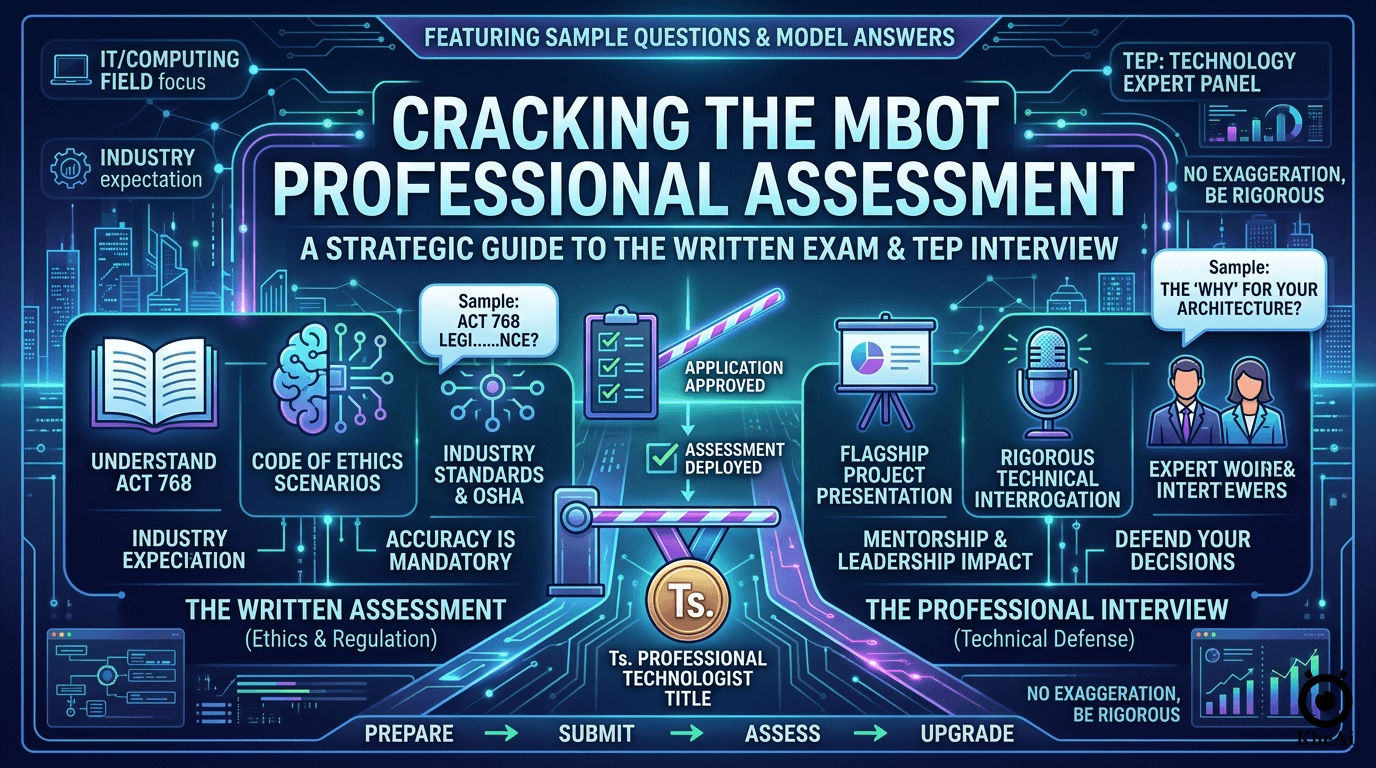
Part 1: The Written Assessment
Before you get to speak to anyone, you have to prove your foundational knowledge. The written assessment is conducted on a regular basis online and will be reviewed by the Technology Expert Panel (TEP).
This is not a coding test or a deeply technical quiz about specific software syntax. It is an evaluation of your professional maturity, ethics, and understanding of the regulatory landscape.
What You Must Master:
- Act 768: Read the Technologists and Technicians Act 2015 thoroughly. Understand the legal definitions, the core functions of MBOT, and the penalties for professional misconduct.
- Code of Ethics: You will be tested on hypothetical scenarios involving conflicts of interest, data privacy, and workplace integrity. Always choose the answer that prioritizes public safety, transparency, and legal compliance.
- Industry Standards: While the questions are generalized, they touch upon Occupational Safety and Health Administration (OSHA) principles and standard project management protocols.
The Strategy: Treat this like an open-book research project. Even if you think you intuitively know the right ethical answer, cross-reference your logic with MBOT’s official guidelines. Accuracy here proves you can operate safely within legal and professional boundaries.
The Written Assessment (Ethics & Regulations)
The written exam evaluates your understanding of professional conduct, safety, and Malaysia’s regulatory frameworks.
Act 768 Knowledge
Question: Under the Technologists and Technicians Act 2015 (Act 768), what is the legal significance of the “Ts.” designation, specifically referring to Section 16?
Model Answer:
“Under Act 768, specifically Section 16, the ‘Ts.’ designation is legally reserved only for individuals who are formally registered with MBOT as Professional Technologists. It signifies that the practitioner has met the rigorous industry standards set by the Board. If an unregistered individual uses this title to offer technological services, they are committing an offense under the Act. As a professional, my liability is to ensure that all system architectures and software deployments I oversee strictly comply with national safety, data security, and ethical standards.”
Workplace Integrity
Question: You discover that a subordinate is accepting kickbacks from a software vendor during a procurement phase. How do you handle this?
Model Answer:
“My immediate action is to suspend the vendor procurement process to prevent any compromised software from entering our ecosystem. I would then formally document the evidence and escalate the matter to top management and HR. Accepting kickbacks is a direct violation of the MBOT Code of Ethics. As a Tech Lead, I have a fiduciary duty to protect my company’s integrity and ensure that vendor selection is based entirely on technical merit, security compliance, and cost-efficiency, not personal gain.”
Part 2: The Professional Interview
This is the main event. The interview process is conducted by the TEP and regulated by the Examination and Qualification Committee after the written assessment is completed. Every assessment is crafted by the TEP to cover the latest technology on the ground and is driven by the industry to ensure professionals meet industry expectations.
You will be facing veteran experts in your specific technology field. Your goal is to defend your technical competency, problem-solving skills, and leadership.
The Anatomy of the Interview:
- The Presentation (10-15 Minutes): You will walk the panel through your technical background, focusing heavily on 2 or 3 flagship projects where you had major ownership.
- The Interrogation (30-45 Minutes): The panel will drill into the specifics of your presentation. Why did you choose that architecture? What were the security implications? How did you handle technical debt?
The Strategy: Do not exaggerate your role. If you made a mistake on a past project, admit it, explain the root cause, and detail the steps you took to rectify it. Panels appreciate a professional who rigorously double-checks their work and learns from inaccuracies over someone who claims flawless execution.
The Professional Interview (Technical Defense)
The interview is typically 15 to 25 minutes long and consists of about 5 core questions. The Technology Expert Panel (TEP) expects concise, impactful, and authoritative answers.
The “Why”
Question: Why are you applying for the Professional Technologist (Ts.) title, and what is your contribution to the organization and society after acquiring it?
Model Answer:
“I am applying for the Ts. title to be formally recognized as a professional in delivering technological services by a statutory body. Beyond personal career growth, this title allows me to contribute to the tech ecosystem via knowledge transfer. Within my organization, I will use this standing to enforce stricter engineering standards and mentor junior developers. For society, I plan to contribute as an industry speaker and potentially serve as an accreditation panelist to help shape the next generation of technologists.”
Crisis Management & Project Delivery
Question: As a Project Manager or Tech Lead, you are given a project and budget, but you realize the budget is overspent and the project is due in two weeks’ time. What do you do?
Model Answer:
“First, I would perform a rapid risk assessment to identify the critical path needed to launch the Minimum Viable Product (MVP) within the two weeks, freezing any non-essential features that are draining the budget. Next, I would immediately prepare a transparent report for top management outlining the root cause of the overspend (e.g., unforeseen cloud infrastructure costs) and present my revised mitigation plan. My priority is delivering a safe, functional product on time while strictly controlling any further financial leakage.”
Sustaining Professional Competency
Question: What is CPD, and what is your actionable plan to collect the required 30 CPD hours annually to maintain your Ts. title?
Model Answer:
“Continuous Professional Development (CPD) is crucial for staying relevant in the rapidly evolving IT field. My action plan to secure the 30 hours involves a mix of internal and external activities. Internally, I will claim hours by conducting technical coaching and architecture review sessions for my engineering team. Externally, I have drafted an action plan to attend industry-recognized seminars and complete specialized technical certifications. This ensures my skills remain sharp and compliant with MBOT’s renewal requirements.”
Case Study: Presenting Like a Tech Lead
To make this concrete, let’s use the public professional footprint of an IT veteran—let’s look at Kai (a seasoned tech leader visible on LinkedIn)—as an operational case study.
If someone with Kai’s background in full-stack development, scalable cloud solutions, and enterprise software architecture were sitting for the Information & Computing Technology (IT) panel, here is exactly how they should structure their defense to secure a strong pass.
1. Frame the Experience Around “Impact,” Not Just “Tasks”
Instead of simply stating, “I manage a team of developers and build web applications,” the presentation should emphasize architectural ownership and business impact.
- The Wrong Way: “I coded the backend infrastructure using Node.js.”
- The Case Study Way: “I architected a microservices backend, implementing automated failovers that reduced system downtime by 40% during peak traffic, ensuring we met our enterprise client SLAs.”
2. Highlight Risk Mitigation and Quality Assurance
TEP members want to see that you do not just build things; you build them safely. A strong candidate like Kheai would showcase a rigorous QA and testing culture.
- Actionable Advice: Detail how you implement CI/CD pipelines, conduct strict code reviews, and enforce security protocols (like data encryption at rest or API rate limiting). Explain your methodology for double-checking code before it ever hits a production environment. This proves you are appropriately skeptical of untested changes and prioritize systemic accuracy.
3. Demonstrate Technical Leadership and Mentorship
Professional Technologists are expected to elevate the industry standard. The panel will look for concrete evidence that you guide and level up others.
- Actionable Advice: Share examples of how you resolve technical disputes within your engineering team. If a junior developer pushes for a trendy but highly unstable framework, how do you steer them back to a more reliable, researched solution? Show the panel that you actively foster a culture of accuracy and critical thinking in your workspace.
4. Prepare for the “Why”
If your case study project involves migrating a massive legacy system to the cloud, the TEP will not just applaud the final result. They will ask: “Why AWS over Azure for this specific workload? What was your cloud cost-optimization strategy?”
- Actionable Advice: Have the hard data ready to back up your claims. Document your technical reasoning, the alternative solutions you researched and ultimately rejected, and the specific business constraints that guided your final architectural decision.
The Bottom Line
The MBOT assessment is deliberately designed to filter out standard practitioners from true professionals. Approach the written test with immense regulatory respect, and treat the interview as a peer-level defense of your engineering philosophy. Build your presentation around verifiable facts, embrace a culture of rigorous double-checking, and let your technical track record speak for itself.