I’ve spent the last several months rigorously analyzing the Artificial Intelligence landscape as it stands today in 2026. What I found is a masterclass in manufactured anxiety.
We are being sold a narrative that missing out on the “AI revolution” is a profound personal failure. But when you look past the marketing and examine the structural mechanics of economic cycles and long-termism, the truth is entirely different. This guide is the culmination of my research. It is a framework to navigate the hype, stop chasing ephemeral tools, and start building defensible, real-world value.
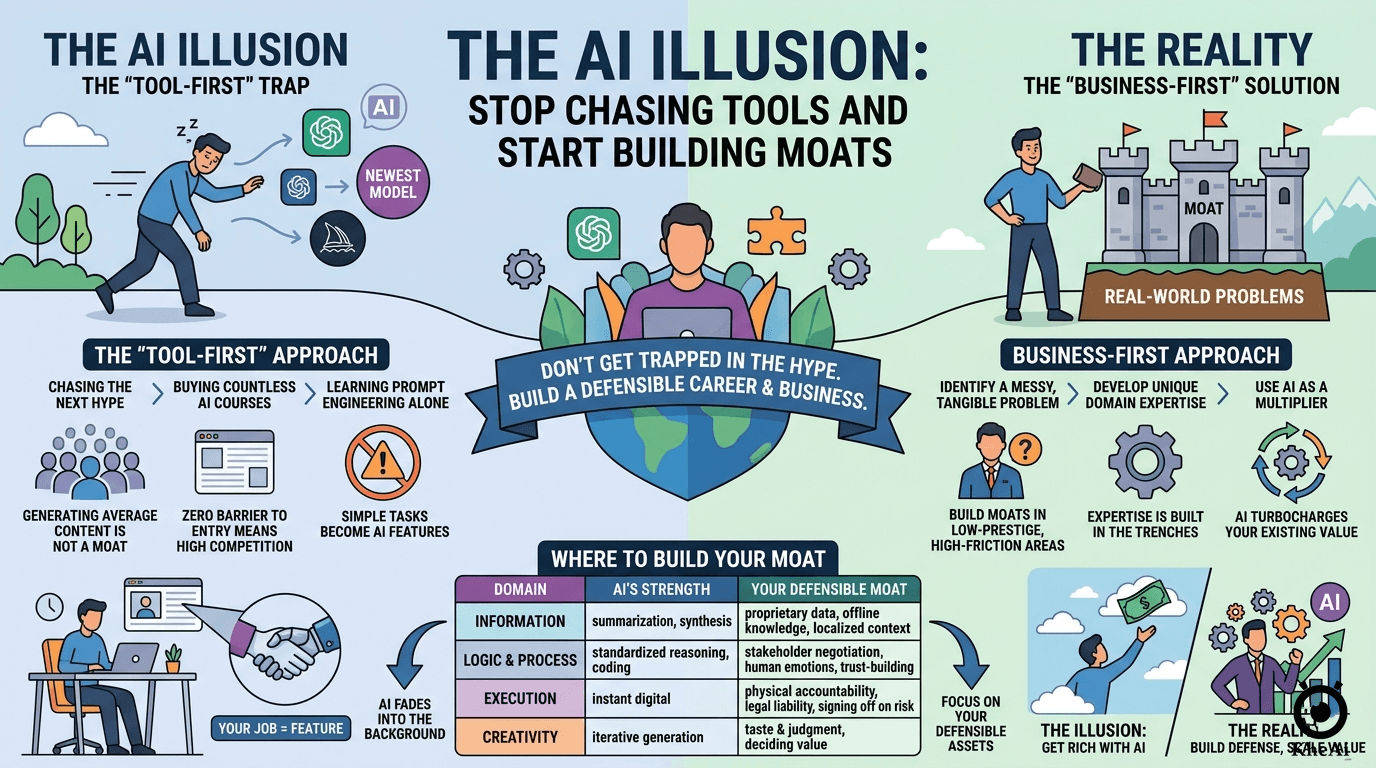
Part 1: Deconstructing the Illusion
To survive the current technological wave, we must first understand how the trap is built. Modern markets rely heavily on emotional vocabulary to coerce compliance and drive consumption. In the tech world, this manifests as “shame-based selling.”
The Myth of the “Cognitive Gap” and Capital Cycles
The script is predictable: You missed the dawn of the internet, you missed crypto, you missed the short-video wave. If you miss AI, it’s because your cognition is too low. Buy my course to fix it.
This is a distraction from macroeconomic reality. The current “AI fever” is largely a byproduct of capital overflow. As traditional investment avenues—like real estate and established mobile internet models—reach saturation, massive amounts of accumulated wealth are desperately searching for a new, expansive track. AI captures the collective imagination, leading to a surge of investment that necessitates “anxiety marketing.” Startups and investors must promote narratives of immediate, apocalyptic disruption to justify their valuations.
When new tech emerges, the individuals who capture the lion’s share of the wealth are the infrastructure owners—those holding the computing power, platforms, and massive proprietary datasets. For the average professional, whose primary asset is limited time and labor, a new tool does not rewrite the economic rules. It simply increases the speed and efficiency of extraction.
Historically (as seen in the 1990s dot-com bubble), the first wave of companies often fails, leaving behind cheap infrastructure for the second wave to truly succeed. Rushing in out of FOMO is a strategic error. There is no “last bus” in a true tech shift; waiting for costs to drop and applications to mature is often the prudent path.
The Core Error: Tool-First vs. Business-First
The most fatal mistake in this landscape is adopting a Tool-First Strategy. This involves spending hundreds of hours learning the intricate prompts of a specific AI model, and only then asking, “How can I make money with this?”
This is the equivalent of buying a high-performance turbocharger and wandering the streets looking for a car to attach it to.
The sustainable, historically proven approach is the Business-First Strategy. AI does not create value in a vacuum; it acts as a multiplier for existing value. You must have a baseline operation, a defined goal, or a real-world problem.
The Reality Check: Instead of trying to invent a brand new “AI logistics app,” look at a traditional delivery fleet operating in the Klang Valley. You use AI to optimize their messy, unpredictable last-mile delivery routes during monsoon season, instantly cutting fuel costs and improving margins. The business and the friction already existed; the AI just solved it.
The Inevitability of Invisibility: Think about electricity or the internet. Today, they are invisible. You do not wake up and think about how to “leverage the internet opportunity”; you just tap an app to pay for your coffee or hail a ride. AI is heading toward this exact endgame. It will fade into the background, integrating seamlessly into the capillaries of the software we already use. Therefore, agonizing over mastering today’s specific AI interfaces is a poor long-term investment.
The Implementation Reality: God-like Tech, Medieval Institutions
Theoretically, AI can replace 80% of modern desk jobs. Yet, the enterprise implementation rate remains shockingly low. Why? Because we currently possess god-like technology, constrained by medieval institutions and prehistoric human emotions. This mismatch creates a chasm between theoretical capability and practical deployment:
- The Liability Barrier: In high-stakes fields like law or healthcare, accountability is non-negotiable. If an AI generates a fatal medical misdiagnosis, who goes to jail? Until institutions allow a corporation to pass legal liability to an algorithm, humans must remain the final signatories. AI takes the blame for nothing; therefore, it cannot take the job.
- Pseudo-Applications: Because of institutional demands for accuracy, AI’s ability to generate rapid code or documents often requires intense manual human oversight just to catch “hallucinations” and bugs, negating much of the promised efficiency.
- Organizational Friction: Integrating AI requires overhauling legacy systems, cleaning years of fragmented, badly formatted data, retraining staff, and navigating strict compliance reviews. This friction costs immense time and capital.
- Tasks vs. Jobs: AI is exceptional at executing specific tasks. However, a job is a complex hybrid of information processing, human negotiation, social capital, office politics, and physical presence. Automating a task shifts the worker’s focus; it rarely eliminates the role entirely.
The Erosion of the “First Job”
While executive roles remain safe, there is a very real casualty: the entry-level “first job.” Traditionally, roles like secretaries, research assistants, and legal interns served as the primary training grounds for understanding how the real world operates. As AI automates this “grunt work,” the admission ticket to professional life is being revoked, threatening to extend the maturation cycle of younger generations. This necessitates a radical shift in how we educate, prioritizing real-world survival skills and socialization over mere knowledge transmission.
Part 2: Radical Materialism (The Operating System)
If the “AI Illusion” is the software used to hack your professional anxiety, Radical Materialism is how you unplug the cable. It is the active practice of cognitive decoupling —observing the socially prescribed “Path” without internalizing it, and acting strictly upon the objective “Requirement” of the terrain. In this era, you must shift your mindset from being an “Examinee” (constantly terrified of failing the test of new technology) to an “Examiner.”
You are the protagonist. You are the judge. If a new technology does not demonstrably improve your specific workflow, it is the technology that has failed the test, not you.
To prevent emotional hijacking by the market, process raw environmental inputs through this strict, three-tiered filtration system:
Layer 1: The Fact (Ontological Baseline)
This is raw, material reality stripped entirely of adjectives, judgments, and emotional weight.
Application: Instead of internalizing a narrative like, “I am falling behind the AI curve and my career is ruined,” you state the exact math: “My company bank account currently holds MYR 0. My immediate liabilities and rent for the month are MYR 2,500.”
Layer 2: The Path (The Societal Script)
This is the predictable, socially engineered reaction to the Fact (panic, buying a useless online course, complaining about the economy being unfair).
Application: Consciously reject this. Map out the mathematically compromised future you refuse to end up in, and use that negative visualization to build bypasses.
Layer 3: The Requirement (The Physics of Execution)
This is the objective, physical action necessary to resolve the Fact.
Application: “I require MYR 2,500 to secure shelter. I will deploy my current skill in this specific local market for 12 hours a day to acquire the capital. The emotional weight of the zero balance, or what tech billionaires are doing right now, is irrelevant to the execution.”
Part 3: The Pragmatist’s Playbook (Executing the Moat)
How do you survive if you are starting from absolute zero, without deep technical expertise? You stop competing in the “clean” digital world where AI thrives, and start building your moat in the “dirty” real world.
1. The “Problem-First” Pivot & Waiting by the Tree
Stop looking for AI features to exploit and start looking for human friction. If a technology is truly revolutionary, it will eventually have to seek out those with the deepest roots and most profound understanding of specific industries.
Capital and top-tier developers focus on clean data (SaaS, global automation). There is a massive, highly defensible moat in low-prestige, high-friction local businesses because the data is “dirty” or simply non-existent online. “Dirty” data that isn’t scraped on the public internet is the most valuable asset in an AI-saturated world.
- AI can write flawless Python code, but it cannot navigate the physical layout of a disorganized transit hub in Subang to find a missing logistics pallet.
- AI can generate flawless marketing copy, but it cannot cultivate a hyper-local network of trusted hardware suppliers in your specific district.
If you are deeply rooted in your industry, you become the “guide” that tech companies desperately need to find real-world applications. Do not abandon your core expertise to chase the wind.
2. Apprenticeship via Efficiency Arbitrage
Because the “first job” is eroding, you must engineer your own entry. Find an established, “old-school” expert —perhaps a traditional business owner who possesses decades of tacit knowledge but lacks technological agility. Handle their grunt work (inventory reconciliation, digitizing records, scheduling) using your AI-assisted speed. You trade your digital efficiency for access to their industry secrets, supplier networks, and hard-earned wisdom. Position yourself as a hyper-efficient protégé, not an “AI guru.”
3. The “Life Aesthetics” and Emotional Moat
As we move toward a spiritually-focused generation, human emotional needs remain a constant that technology cannot replicate. In service-oriented businesses, value is not merely the product, but the advice, empathy, and human connection.
Never build a career around being “average.” AI is the ultimate engine of average.
The Rule of Zero dictates: If your daily workflow or core service can be clearly explained to a machine in a 10-paragraph prompt, it is not a career; it is a feature waiting to be automated into a free app.
Furthermore, as AI mass-produces average content, “Aesthetics as Productivity” becomes a legitimate competitive advantage. The ability to “play” and curate unique, authentic human experiences is a premium asset. We see this in the global rise of “plain-folk culture”—from relatable web novels and short dramas to culturally rich games like Black Myth: Wukong. These succeed globally not through synthetic corporate generation, but through authentic, relatable human design. Your unique taste is a variable of certainty algorithms cannot easily fake.
4. Building a “Friction Hunter” AI
Do not use AI to brainstorm “business ideas”—it will just give you the same generic internet scrape everyone else sees. Instead, configure your AI to be a Friction Hunter.
- Feed it Dirty Data: Input 500 local one-star reviews from a boring, highly fragmented service industry (e.g., commercial aircon servicing in Selangor) and prompt it to find recurring human frustrations, manual bottlenecks, and communication failures.
- The Anti-AI Filter: Run your business hypotheses through a prompt that acts as a skeptical investor: “Identify the one part of this business that requires a human to sign a legal contract or take physical accountability on-site. If that doesn’t exist, tell me why this digital-only business is a trap.”
Conclusion: Anchor Power & The Process Auditor
In an era of high uncertainty, your greatest advantage is “Anchor Power”—internal stability derived from maintaining control over your immediate life, work, and narrative.
To survive this AI Age, you must stop thinking like a software developer and start thinking like a process auditor. You aren’t selling “intelligence.” You are selling the removal of a headache that costs a business money, time, or legal liability. By focusing on long-term accumulation and remaining rooted in human-centric skills, the anxieties generated by the hype cycle will dissipate. Find the friction, apply the tool, and own the outcome.