When you are a solo founder—especially a non-technical one relying on AI assistance—your most valuable asset is time. You need a tool that minimizes context switching and boilerplate management. You want to spend your energy building features, not wiring together disparate libraries.
After rigorously testing the modern landscape, I have compiled this definitive guide to help you choose the right web framework for your startup. We are going to strip away the vanity metrics, look at the cold hard data, and figure out how to maximize your operational efficiency.
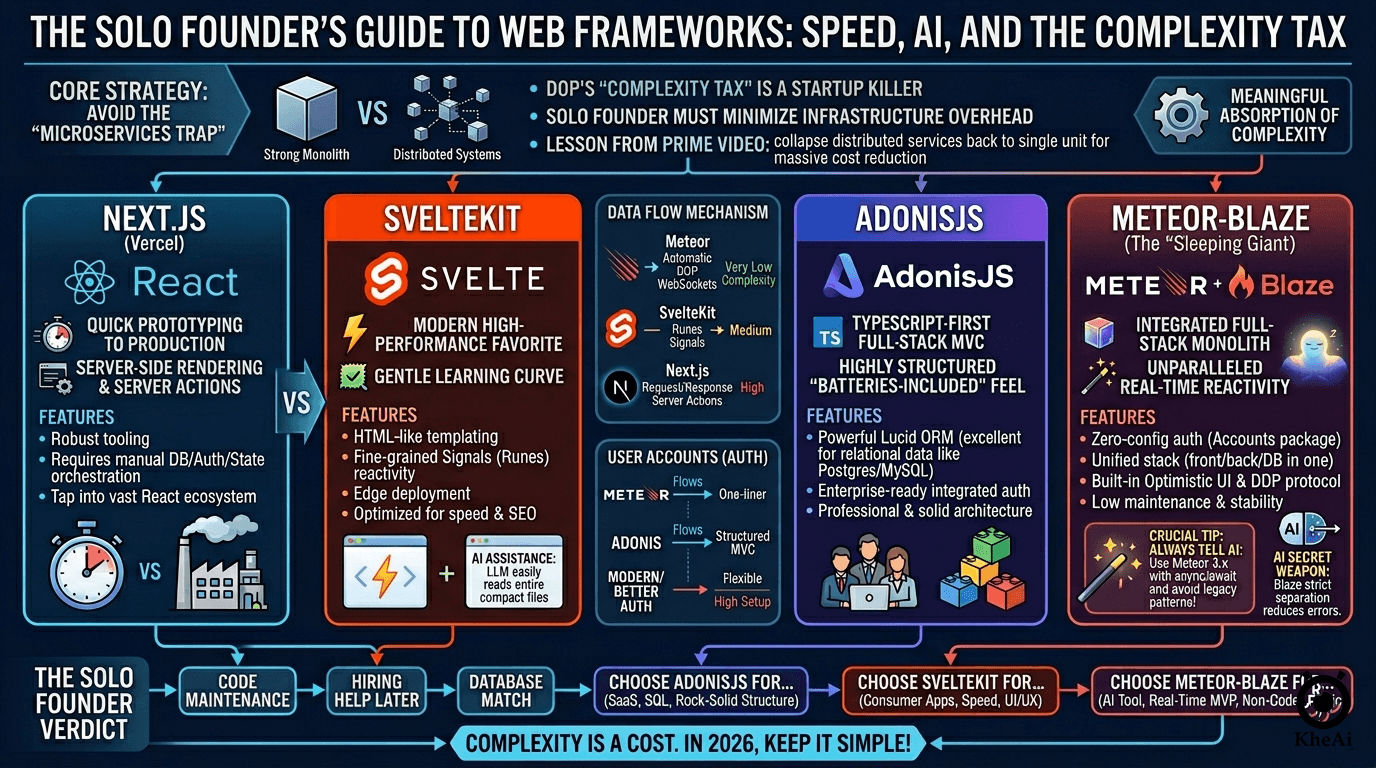
Avoiding the Microservices Trap
In the early 2020s, the “scaling ceiling” drove a mass exodus toward microservices and distributed serverless architectures. We were told that a single codebase was a “failure blast radius” waiting to explode.
But as we sit here in 2026, the data is clear: for the solo founder, the “Complexity Tax” of distributed systems has become a silent startup killer. The shift to microservices necessitates an entirely new (and expensive) layer of infrastructure. Container orchestration makes you an involuntary Site Reliability Engineer (SRE). Service meshes introduce silent, production-level failures. Furthermore, the “network hop” between services introduces latency that compounds until your throughput is constrained by the architecture itself.
The Prime Video Reality Check
Amazon’s Prime Video team provided the ultimate wake-up call a few years ago. They initially built their video quality monitoring as a distributed, serverless system. Upon realizing the services were actually a sequential chain, they collapsed them back into a single monolithic unit. The result was a 90% reduction in infrastructure costs and the elimination of the network overhead that was throttling their system.
If you prioritize operational efficiency over architectural vanity, your choice of framework is no longer about “modern vs. old.” It is about the meaningful absorption of complexity.
The Modern Contenders (A Reality Check)
The industry loves to push the newest shiny object, but a solo founder needs reliability and speed. Here is the honest, deduplicated breakdown of the top frameworks competing for your attention today:
- Next.js (React): The premier choice for quick prototyping to production, heavily backed by Vercel. It offers robust tooling and Server Actions, but it operates on a Request/Response mechanism that requires manual orchestration for real-time layers. You must manually stitch together your database, authentication, and state management.
- SvelteKit: The modern favorite for high performance. It features a gentle learning curve and uses a straightforward, HTML-like templating system. Thanks to Svelte’s “Runes,” it handles fine-grained reactivity brilliantly, updating specific DOM nodes without heavy browser overhead.
- AdonisJS: A TypeScript-first, full-stack MVC framework. If you want the highly structured, enterprise-ready feel of Laravel but in the JavaScript ecosystem, this is a productivity powerhouse. It features a powerful Lucid ORM, making it vastly superior for complex relational SQL data (PostgreSQL/MySQL).
- FeathersJS: A lightweight alternative if you need real-time APIs quickly and want to bring your own database.
- Blazor: A top choice strictly for those already comfortable with C# and .NET, allowing you to build interactive UIs without touching JavaScript.
The “Meteor Renaissance”
If the lesson from the 2020s is that monoliths are better for efficiency, the question remains: Which monolith?
Often dismissed in the past as outdated, the architectural discourse has returned to the Integrated Full-Stack Monolith, specifically Meteor. The release of Meteor 3.0—which killed the legacy “Fibers” in favor of native Node.js async/await—sparked a modernization wave. Now, with Meteor 3.4 and 3.5, the old criticisms of proprietary tools and slow refreshes are dead.
- Modern Build Stack: By integrating Rust-based bundlers like Rspack and SWC, builds are drastically faster with near-instantaneous Hot Module Replacement (HMR). You get the speed of modern tools with the power of a full-stack engine.
- Tree Shaking & ESM: Native ECMAScript Modules (ESM) support means bundle sizes are massively reduced compared to the 2.x era.
- MongoDB Change Streams: Legacy “oplog tailing” has been replaced with native Change Streams, providing high-scale, real-time data synchronization without the massive CPU overhead of the past.
- Superior “Batteries-Included” Experience: Meteor gives you a unified stack. You use one language across the frontend, backend, and database queries. Its zero-config Accounts package handles everything from basic email/password to OAuth instantly.
- Built-in Real-Time Reactivity: Data streaming is built into its core DDP (WebSocket) protocol. Meteor provides Optimistic UI out of the box; when a user makes a change, the UI updates instantly while the server synchronizes in the background.
The AI Factor
If you are a non-technical founder using AI (like Claude, ChatGPT, or Cursor) to build your startup, the framework you choose changes how effectively the AI can assist you.
Why SvelteKit Shines with AI
Svelte files are incredibly compact. You can feed an entire Svelte page into an LLM, and it will understand the complete context instantly. Modern AI code editors are heavily optimized for the SvelteKit ecosystem, meaning the AI naturally “prefers” generating this code.
Why Meteor-Blaze is an AI Secret Weapon
While the industry chased the complex hooks of React, Blaze 3 doubled down on low cognitive load. Blaze enforces strict separation of concerns: HTML for structure, Helpers for data, and Events for interactions. When you ask an AI to fix a button, it will not accidentally break your database logic because they live in completely different areas. This makes verifying the code yourself significantly easier and reduces AI hallucinations. Additionally, Meteor’s built-in DDP streaming protocol makes setting up things like the “typing effect” for AI text generation native and simple.
The Head-to-Head Breakdown
Understanding how these frameworks handle the foundational pillars of an application is critical. Here is how the top three solo-founder stacks compare:
| Criteria | AdonisJS | SvelteKit | Meteor-Blaze |
|---|---|---|---|
| Speed to MVP | High | Medium / High | Highest |
| Data Reactivity | Request/Response | Fine-grained Signals (Runes) | Automatic Subscriptions (DDP) |
| Authentication | Integrated (CLI generated) | Manual (Better Auth / NextAuth) | Integrated (Accounts-Base) |
| Code Maintenance | Easiest (Highly Opinionated) | Moderate | Low (If using modern async/await) |
| Database Match | SQL (Postgres/MySQL) | Any Database | MongoDB (Strictly) |
The Final Verdict
The decision between a monolith and microservices isn’t a binary choice between “old” and “new.” It is a calculation of your inconsistency tolerance and infrastructure budget.
Do not let the tech ecosystem dictate your stack. Choose the tool that fits your specific product and your ability to verify the work.
- Choose AdonisJS if you are building a SaaS or Business Tool with complex relational data and need it to be rock-solid and structured. It provides the “full engineering team” feel.
- Choose SvelteKit if you are building a Content or Consumer App where speed, SEO, and UI/UX are your primary selling points. It is the modern standard for a reason.
- Choose Meteor-Blaze if you are building an AI tool or real-time collaborative app and need the absolute easiest time with User Accounts and Database setup. It remains the closest thing to magic for a solo operator.
Complexity is a cost, not a sign of sophistication. In 2026, the most sophisticated thing you can do is keep it simple.
Tip: If you choose Meteor, always explicitly instruct your AI: “I am using Meteor 3.x with Rspack and Blaze 3. Use async/await for all database calls and avoid any legacy Fiber-based patterns.” This ensures the AI gives you high-performance, modern code rather than hallucinating outdated syntax from five years ago.