We like to think of ourselves as entirely logical machines. We write out our pristine to-do lists, map out project architectures, and set audacious deadlines, fully expecting our minds to execute the plan flawlessly.
Then Monday morning arrives.
Instead of writing that critical system architecture or executing that high-priority task, you find yourself deep down a rabbit hole reading about 14th-century agriculture, paralyzed by a vague sense of dread, or waiting until 3:00 AM the night before a launch to finally let a surge of raw panic fuel your work.
For a long time, I blamed my lack of willpower. I thought I just needed to be tougher, more disciplined, or more “robotic.” But after diving into systemic autonomy frameworks and exploring how both advanced AI agents and biological systems manage complex, conflicting priorities, I had a massive epiphany: We are not a single monolithic consciousness. We are an ecosystem.
To build a truly sustainable workflow—whether you are designing an autonomous software system or trying to optimize your own life—you cannot suppress your chaotic internal subsystems. You have to learn how to orchestrate them.
Here is the exact architectural framework I discovered and implemented to stop fighting my mind and finally get along with my inner Snake, Monkey, and Panic Monster.
The Evolutionary Blueprint: Mapping Metaphor to Biology
Before we can manage these internal forces, we need to understand that they aren’t design flaws; they are deeply hardwired evolutionary features. When we map these psychological metaphors to actual human neuroscience, we see a striking correlation with how our brains developed to process threats, rewards, and survival.
When we look at this neurological layout, our three internal characters suddenly make perfect sense:
- The Snake lives in the ancient brainstem and basal ganglia—the oldest structures designed for instantaneous survival.
- The Monkey dominates the broader limbic system, chasing emotional resonance, social status, and quick dopamine hits.
- The Panic Monster relies on the amygdala, ready to trigger an immediate amygdala hijack (where the emotional panic button overrides your rational prefrontal cortex) when a survival threshold is crossed.
Here is how I learned to stop caging these creatures and started treating them as critical components of my personal operating system.
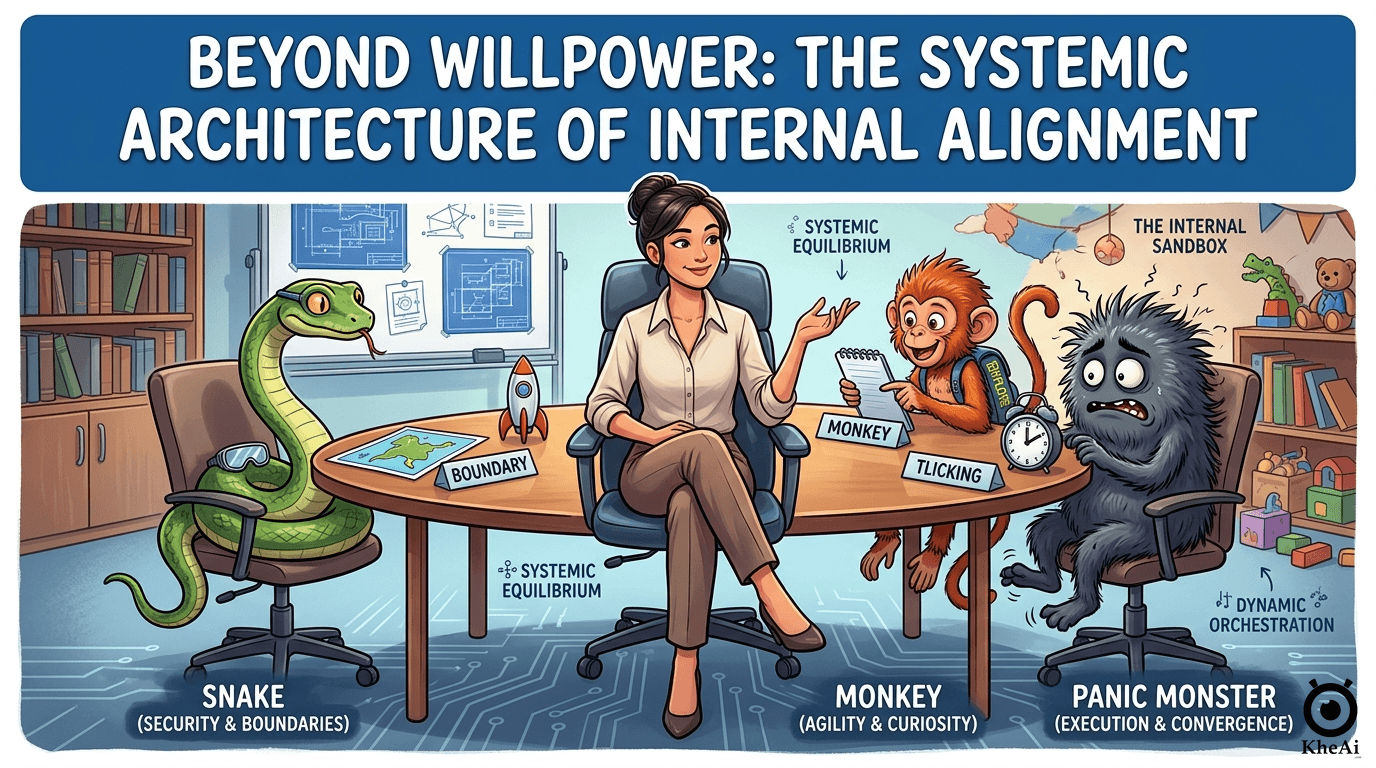
1. The Snake: The Hyper-Vigilant Security Guard
The Snake represents raw instinct, immediate threat detection, and defensive isolation. It’s the part of you that flashes a warning sign the moment a task feels exposed to failure, public criticism, or profound discomfort.
The Failure Mode
If you try to fight or ignore the Snake, you end up trapped in a state of hyper-vigilance or complete paralysis (the “freeze” response). In an autonomous software system, this looks like an over-tuned safety protocol that continuously aborts operations because the risk threshold is set to zero. In my life, it manifested as creative avoidance—procrastinating on a project not because I was lazy, but because the Snake smelled a threat of failure and quietly shut down my motivation before I could even try.
How I Learn to Get Along with It
I stopped trying to convince the Snake that “everything is fine.” The Snake doesn’t understand logic; it understands boundaries. I now treat it as a silent, deeply respected security guard.
The Strategy: I establish hard, uncompromised safety boundaries. If I am testing a risky new project or writing an edgy piece of content, I tell myself, “I am just writing a messy draft in a private local file. Nobody will ever see this version.” By shrinking the surface area of the threat, the Snake lowers its fangs, steps back into the shadows, and lets me build in peace.
2. The Monkey: The Dopamine-Chasing Innovator
Popularized by writer Tim Urban, the Monkey is the creature that craves instant gratification. It is restless, hyperactive, easily distracted, and obsessed with whatever is shiny, novel, or comfortable right now.
The Failure Mode
The traditional approach to productivity is to put the Monkey in a cage. We lock our phones in drawers, install aggressive website blockers, and try to force ourselves into hours of uninterrupted, monotonous focus. But a caged monkey eventually breaks the bars. When your willpower dips, the Monkey hijacks the wheel completely, leading to massive multi-day procrastination benders and a total collapse of consistency.
How I Learn to Get Along with It
I realized that the Monkey isn’t a malicious saboteur; it’s actually the source of my creativity, agility, and lateral thinking. If a system has zero room for play, it becomes fragile and unable to innovate.
The Strategy: The Sandbox Method. Instead of banning the Monkey, I give it a dedicated sandbox and a budget. When I am working on a dense, multi-week project, I explicitly schedule “exploration cycles.” I tell the Monkey, “For the next 45 minutes, we execute this core roadmap. After that, you get 15 minutes to research whatever random, weird technology or trend you want.” By treating the Monkey’s curiosity as a feature rather than a bug, I keep my energy levels high without derailing my primary objectives.
3. The Panic Monster: The Toxic Firefighter
The Panic Monster is a sleeping beast that only wakes up when a situation becomes truly critical—usually when an absolute, unyielding deadline is staring you dead in the face. It floods your system with cortisol and adrenaline, granting you an almost superhuman burst of terrifying, single-minded focus.
The Failure Mode
For years, my entire workflow was built on a toxic codependency between the Monkey and the Panic Monster. The Monkey would play until the situation was desperate, and then the Panic Monster would wake up to save the day at the absolute last second. While this can yield short-term results, the long-term systemic debt is catastrophic. It causes immense physical burnout, severely degrades the structural quality of your work, and ensures you are constantly playing defense instead of building proactive value.
How I Learn to Get Along with It
You can’t eliminate the Panic Monster completely; urgency is a highly effective tool for closing loops and preventing perfectionism. The trick is preventing it from acting as an emergency first responder that only arrives when the house is already burning down.
The Strategy: Simulated Convergence. I now use micro-deadlines and highly specific, public forcing functions to gently wake the monster up early, turning destructive panic into structured focus. For example, instead of setting a massive 3-month deadline, I commit to delivering a small, tangible micro-feature to a peer or client every single Friday morning. The monster wakes up as a minor, manageable presence on Thursday afternoon, forcing me to trim the fat and ship the code, without causing a massive systemic meltdown.
The Blueprint for Internal Alignment
To pull all of this together, I developed a structured sequence that I run through whenever I feel myself slipping into friction, avoidance, or chaos. This is my four-step process for realigning the system in real-time:
- Identify the Hijacker: Pause and check your internal telemetry. Ask yourself: Who is running the control room right now? Am I frozen in fear (Snake)? Am I scrolling mindlessly for a quick hit of novelty (Monkey)? Or am I vibrating with high-stress urgency (Panic Monster)? Simply labeling the active state weakens its unconscious grip on you.
- Negotiate Safety boundaries: If the Snake is active, lower the stakes immediately. Isolate your environment. Reduce the scope of your next step until it feels completely safe. Write the worst possible sentence, or build the crudest possible prototype. Assure your survival loops that failure here carries zero systemic risk.
- Feed the Monkey a Small Snack: Don’t try to force absolute focus if your brain is starved for engagement. Give the Monkey a highly bounded, constructive task that yields quick momentum. Solve a minor, satisfying bug, clean up a single file, or promise it a tangible reward the moment a specific block of work is complete.
- Trigger Controlled Urgency: Set a timer for exactly 20 minutes (the Pomodoro technique, customized for system convergence). Tell yourself that when the timer rings, you are allowed to stop. This minor artificial constraint nudges the Panic Monster just enough to clear away lingering friction and initiate a flow state.
The Internal Synthesis Matrix
When you stop treating your mind as a battleground and start viewing it as an orchestrated system of autonomous components, your relationship with work changes entirely. Here is how these pieces fit together when they are operating in harmony:
| Internal Entity | Core Triggers | Failure State (Mismanaged) | Optimal System Role (Aligned) |
|---|---|---|---|
| The Snake | Ambiguity, high exposure, risk of public failure. | Paralysis & Defensiveness: Total stagnation, avoidance of hard things. | Systemic Boundaries: Acts as a bulletproof safety net, warning you of genuine architectural hazards. |
| The Monkey | Boredom, repetition, low-dopamine tasks. | Chaos & Distraction: Chasing shiny objects, infinite rabbit holes, broken focus. | Agility & Innovation: Drives lateral thinking, creative problem solving, and joyful exploration. |
| The Panic Monster | Proximity to deadlines, absolute constraints, exposure. | Burnout & Crisis Management: Chronic stress, sloppy execution, high technical debt. | Forced Convergence: Cuts through over-thinking, eliminates perfectionism, and drives execution to the finish line. |
The Long-View: Building an Evergreen System
True systemic autonomy—whether for an AI architecture or for your own human mind—is never about achieving a state of sterile, permanent perfection. It is about dynamic equilibrium.
I used to spend a massive amount of emotional energy feeling guilty about my distractions, my fears, and my procrastination. Once I shifted my point of view to see these behaviors as natural inputs from deeply integrated evolutionary subsystems, the guilt evaporated. I stopped trying to kill the snake, cage the monkey, and run from the monster.
Instead, I built a boardroom, sat them all down at the table, and took my place as the chairperson. They all have incredibly valuable perspectives to offer—as long as they aren’t allowed to hijack the microphone.
The next time you find your day fracturing into chaos, don’t double down on raw willpower. Take a step back, look at your internal ecosystem, and ask yourself: What do my subsystems need right now to get back into alignment?