We are officially living through the SaaSpocalypse.
For the last decade, the tech industry sold us a compelling lie: “Buy this software, and you’ll be more productive.” But by 2026, the market has reached a breaking point. We are exhausted by “seat-based” pricing. We are tired of managing a dozen different dashboards just to do one job.
We don’t want a better place to do our work; we want to pay for work that is already done.
I had this epiphany during a late-night session analyzing market liquidity. I was staring at a screen, downloading PDFs, checking signals, and formatting reports. Technically, I was doing “expert” work, but 80% of it was repetitive data handling. As someone with a background in actuarial statistics, I did the math: my effective hourly rate for that task was equivalent to a junior analyst. I was acting as the engine when I should have been the Architect.
This realization marks the great transition of our era: moving from Time Leverage (hiring people) to Algorithm Leverage (codifying judgment). Welcome to the era of Agent-as-a-Service (AaaS).
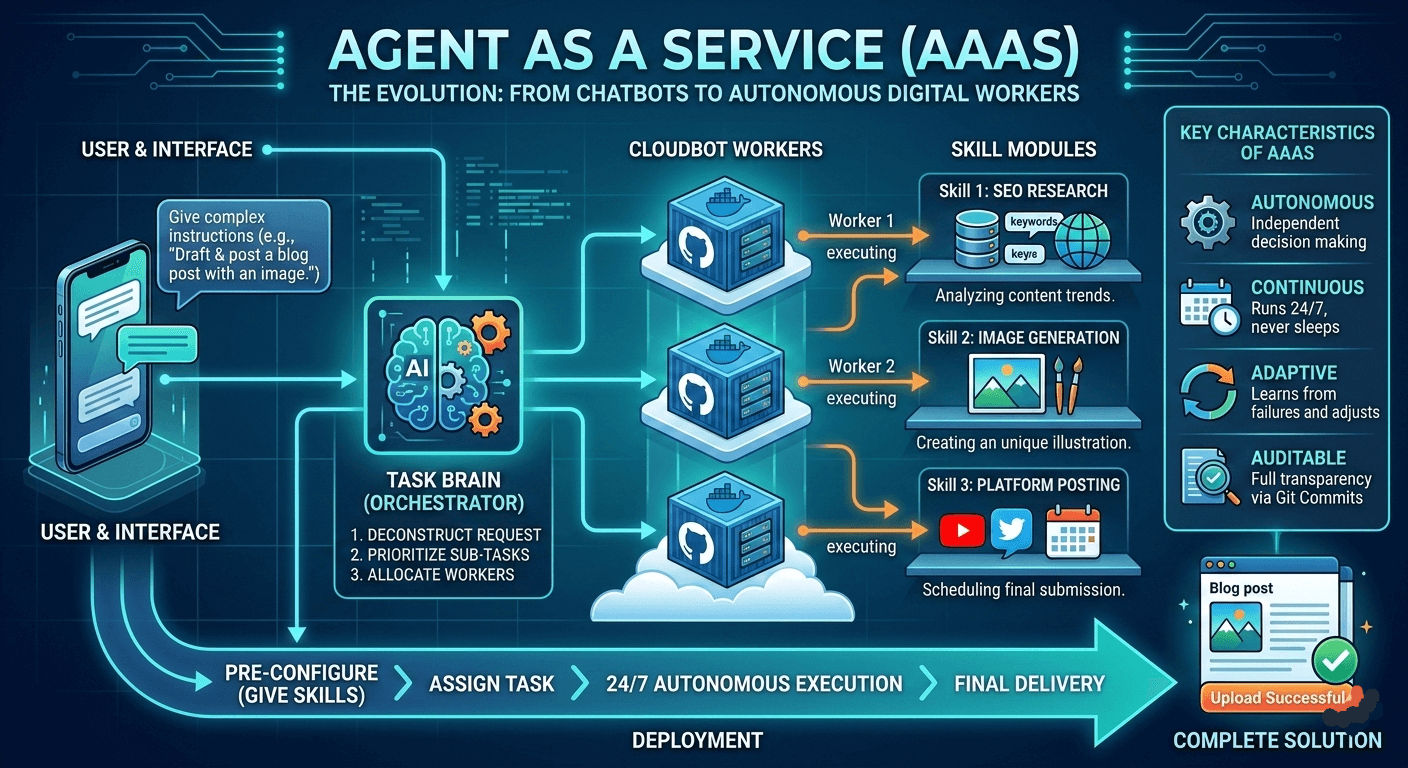
The Paradigm Shift: Software vs. Sovereignty
SaaS sells you a hammer and tells you to build a house. AaaS sells you the finished house.
In this new paradigm, an “Agent” isn’t a conversational chatbot you babysit. It is an autonomous delivery engine for niche expertise. The formula is simple:
AaaS = Knowledge + Skills + Service
This shift effectively kills the traditional “billable hour.” If you can structure your knowledge, you have a business. You don’t need a 10-person agency; you need to “Agent-ize” your brain.
The 3-Layer Architecture: Building a Digital Worker
When I build “sovereign” digital workers—whether they are running on a local Raspberry Pi cluster or the edge—I use a strict three-layer architecture. This is how you turn a flimsy prompt into an industrial-grade system.
Layer 1: The Knowledge Base (The Moat)
Large Language Models (LLMs) are commodities; your data is your competitive advantage. This layer is a structured database of your “secret sauce”—historical data, custom indicators, and curated inputs.
- The Impact: Because an agent has historical context, it can flag a liquidity signal that a vanilla, context-less AI would ignore. It transforms “AI” into “Your AI.”
Layer 2: The Skills (The Tools)
This is where personal expertise becomes software through atomic, single-purpose capabilities.
- The Strategy: Keep skills narrow. A “YouTube Sentiment Analyzer” or a “GitHub PR Reviewer” should do one thing perfectly. The more specific the rule, the fewer hallucinations the system produces.
Layer 3: The Service (The Worker)
This is the autonomous orchestration layer — the “brain” that knows when to use a skill and how to evaluate the result. It operates 24/7 without human intervention.
- The Workflow: At 7:50 AM, the system triggers, runs its skills against the knowledge base, and pushes a formatted summary to your phone. It never sleeps, never panic-sells, and reduces hours of “admin” to minutes of “review.”
Defining the “Agent”: Tool vs. Skill vs. Sovereign
To understand AaaS, we must distinguish between a tool and a sovereign entity. An Agent is a sovereign actor that operates on a “Why” (Mission) rather than just a “How” (Task).
Read: The Tool (The “What”) vs The Skill (The “How”)
The Four Pillars of a Sovereign Agent
- Self-Correction: It monitors its own output. If an API fails or a script returns an error, it diagnoses the issue and tries a different approach.
- Memory: It maintains long-term context. It knows the price of an asset ten minutes ago without being reminded.
- Metabolism: It manages its own resources—API credits, compute cycles, or even digital currency in a Lightning wallet. It understands its “cost of living.”
- The Logic Layer: It uses a foundational philosophy to make decisions. When a conflict arises, it refers back to your “Architect’s Intent.”
The Evolution Summary: From Hammer to Humanoid
| Feature | Tool (SaaS) | Skill (Script) | Agent (AaaS) |
|---|---|---|---|
| Action | Reactive | Procedural | Autonomous |
| Human Role | Operator | Practitioner | Architect |
| Unit of Work | Single Task | Workflow | Objective / Mission |
| Resilience | Fails on bad input | High (Iterative) | Sovereign (Self-healing) |
| Component | API / Database | Script / Logic | Autonomous Entity |
| Activity | ”Here is the data." | "I’ve organized the data." | "I’ve acted on the data for you.” |
| Human Effort | High (Manual retrieval) | Medium (Management) | Low (Architecture) |
AaaS in Practice: The “Buy the Dip” Agent
Let’s look at a Bitcoin tracker.
- A Tool gives you the price.
- A Skill organizes that price into a spreadsheet.
- An Agent executes a mission:
Monitor BTC. If it drops 5% in an hour, notify my Telegram. If I have liquidity in my Lightning wallet, zap 1,000 sats to my Nostr post.
The Agent has metabolism (managing the wallet) and logic (deciding to act based on strategy). You aren’t clicking “Run” anymore; you are observing a system you birthed.
The Architect’s Warning: Reliability is the Product
It is easy to get swept up in the hype of “magic” agent frameworks. But having spent years in industrial automation, I can tell you: Reliability is your only real product.
If your agent hallucinates a financial metric or sends an inaccurate report, it is a liability. To achieve enterprise-grade results, you must build Verification Loops. Use a secondary, smaller agent to “cross-examine” the work of the first against a strict rubric. Trust, but verify.
Final Thought: From Operator to Architect
This shift from manual tasks to autonomous systems is more than a technical upgrade; it’s a shift in identity. You are moving from being the operator of a machine to the architect of an entity.
By focusing on the Agent rather than the Tool, you reclaim your time and your sovereignty. You aren’t just building code; you are building a digital companion that manages your interests while you focus on the big picture—the life of a modern “city hermit” where technology serves the man, not the other way around.