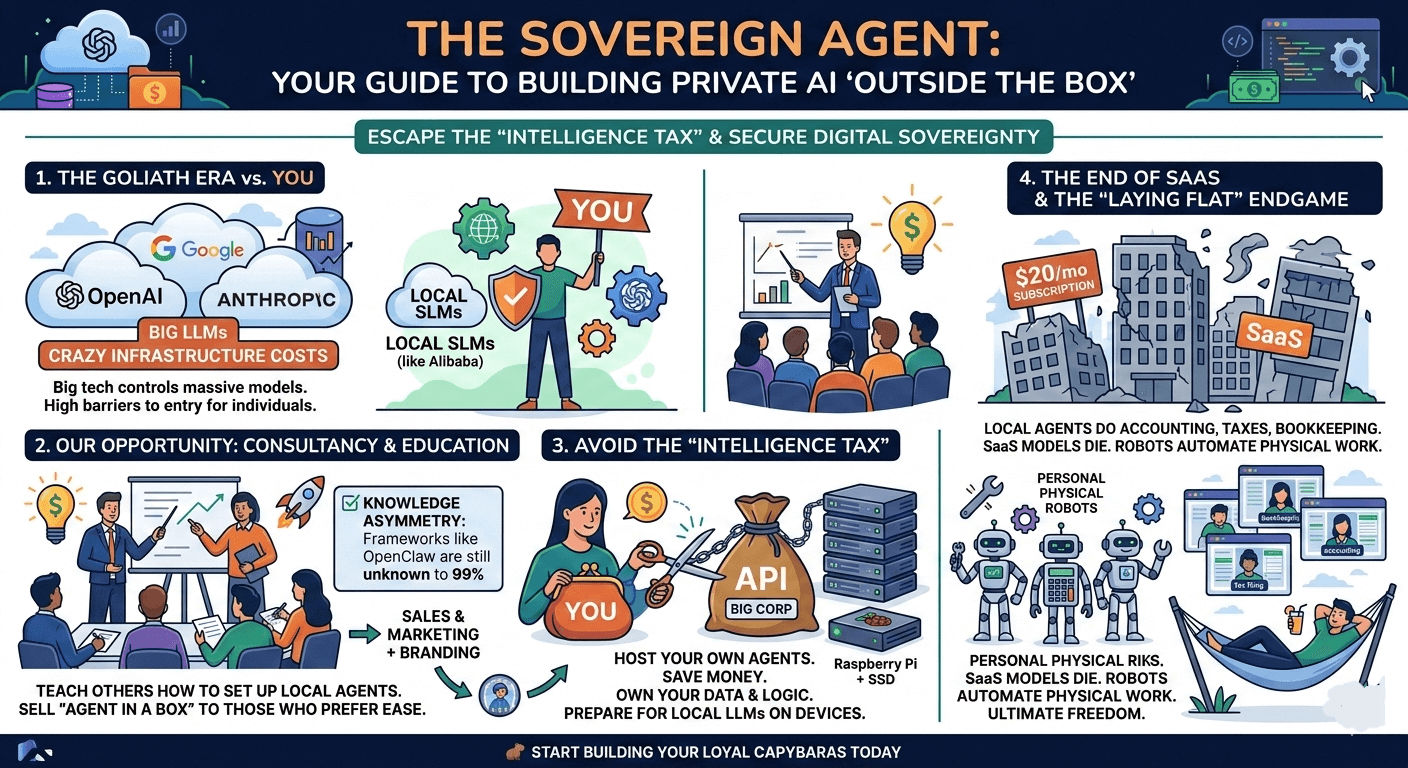
We are currently witnessing a “Goliath” era of Artificial Intelligence. The massive Large Language Models (LLMs) are firmly in the hands of the giants—OpenAI, Google, and Anthropic. Meanwhile, the Small Language Model (SLM) space is being carved up by players like Alibaba. For most of us, the infrastructure required to compete at that level involves “crazy” upfront investment that just isn’t realistic.
So, where does that leave the rest of us?
As someone deep in the trenches of AI agent frameworks, I’ve realized that the real frontier isn’t in building the biggest brain—it’s in orchestrating the agency.
1. The “AI Agent in a Box” Reality Check
The idea of selling a pre-configured “AI Agent in a Box” is tempting. It’s a tangible product. But let’s be real: the tech space is crowded. Even here in Kuala Lumpur, the density of “techies” is skyrocketing. If you’re just selling a box, you’re in a high-competition commodity race.
However, there’s a secret weapon: Information Asymmetry. While the AI community feels saturated to those of us inside it, the general public is still catching up. Frameworks like OpenClaw or PopeBot are still “hidden gems” to 99% of the world.
2. My Strategy: Education First, Hardware Second
I’ve realized that my competitive advantage isn’t just the hardware—it’s the Consultancy and Education. The business model is simple:
The Hook: Teach others how to set up their own autonomous agents at the lowest cost possible (think Raspberry Pi or local hardware).
The Pivot: If they find it too complex, get “lazy,” or hit a wall—that’s when we provide the “AI Agent in a Box” as a premium, friction-free solution.
The Value: We aren’t just selling tech; we’re selling Digital Sovereignty.
3. Avoiding the “Intelligence Tax”
Why go local? Because I want to avoid the “Intelligence Tax.” Every time you ping a Big Corp’s API for a simple task, you are paying a micro-toll to a centralized power. When Apple eventually rolls out local LLMs on iPhones, the world will start to realize that “local” is the only way to ensure privacy and uptime.
By hosting your own agents—whether they are running on a Raspberry Pi with an SSD or a dedicated local server—you own the logic. You own the data. You own the “worker.”
4. The End of SaaS as We Know It
The future is going to be wild. If everyone has a personal AI agent capable of handling:
- Real-time bookkeeping
- Automated tax filing
- Personalized accounting
- Schedule orchestration
…then most traditional SaaS (Software as a Service) platforms will simply die. Why pay $20/month for a subscription when your local agent can perform the same task for the cost of a few watts of electricity?
5. The “Laying Flat” Endgame
Eventually, these AI agents will move from our screens into physical robots. Once your digital agents are earning for you and your physical agents are maintaining your lifestyle, we might finally reach the “laying flat” (chilling) stage of human evolution.
But to get there, we have to start now. We have to learn to build, manage, and deploy our own “Loyal Capybaras”—autonomous agents that work for us, not for a tech conglomerate.
The goal is clear: Stop being a consumer of AI, and start being an orchestrator of it.
Also read Individual’s Playbook - Thriving in the Intelligence Infrastructure Age