I’ve spent the last few months skeptical of the “AI hype.” I assumed we were just looking at another software cycle. I was wrong. After digging into the thermodynamics of computation and the actual state of our energy grid, I’ve realized that we aren’t just building better chatbots; we are participating in the most resource-intensive industrial pivot in human history.
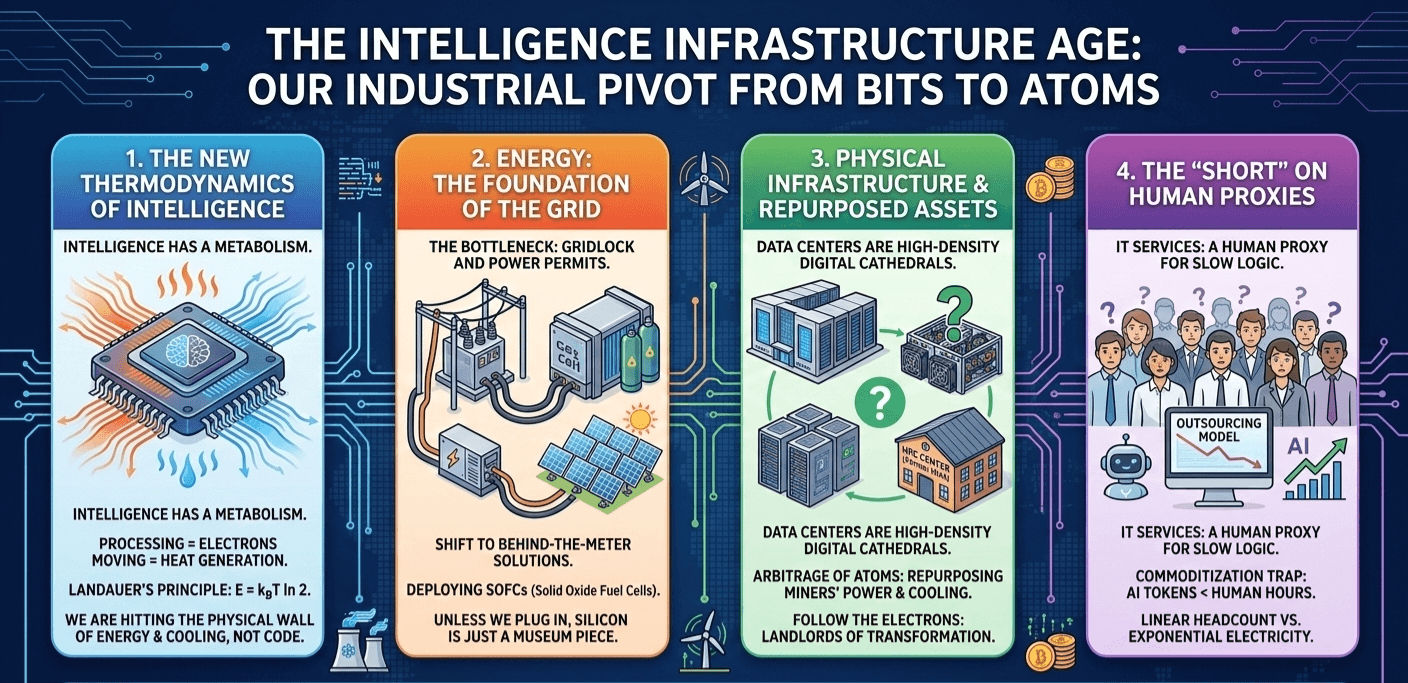
Here is what I’ve learned about the shift from Bits to Atoms, and why the “Intelligence Age” is actually an “Infrastructure Age.”
1. Intelligence is a Thermodynamic Process
We tend to think of AI as an abstract mathematical construct. But physics tells a different story. To process information, you must move electrons, and moving electrons generates entropy (heat).
I’ve been looking into Landauer’s Principle, which establishes the minimum energy required to erase a single bit of information. The formula is:
Where is the Boltzmann constant and is the absolute temperature of the circuit. While our current GPUs are nowhere near this theoretical floor, the sheer scale of modern training runs means we are hitting a “Physical Wall.” We are no longer limited by how clever our code is; we are limited by how much heat we can dissipate and how much “ordered energy” we can pump into a system. Intelligence has a metabolism.
2. The Great Decoupling: Why I’m Looking at the Grid
I used to follow GPU release cycles. Now, I follow transformer (the electrical kind, not the architecture) lead times. The bottleneck has moved “downstream” from the silicon to the substation.
- The Gridlock: In many parts of the world, it takes 5 to 7 years to get a new high-voltage connection for a data center.
- The Solution: This is why I’m seeing a massive surge in “behind-the-meter” power. Companies are deploying Solid Oxide Fuel Cells (SOFCs) to generate power on-site, bypassing the grid entirely.
If you have a 100,000-GPU cluster but no way to plug it in, you don’t have an AI company; you have a very expensive museum of silicon.
3. The Arbitrage of Atoms: Re-purposing the Past
One of the most interesting “pivots” I’ve researched involves Bitcoin miners. For years, they were criticized for their energy consumption. Now, they are the “landlords” of the AI era.
Why? Because they possess the two most valuable assets in the physical world: Power Permits and Cooling Infrastructure. I’ve watched firms transition from mining blocks to hosting High-Performance Computing (HPC) for AI. It’s a brilliant move—they are essentially selling their “plumbing” to a more profitable tenant. In a gold rush, don’t just buy the shovel; buy the land that has the water rights.
4. The “Short” on Human Proxies
I’ve had to rethink my stance on the IT service industry. For decades, we used “IT Outsourcing” as a human proxy for computation. We paid thousands of people to act as manual logic gates—writing basic code, testing software, and managing databases.
The Realization: When the cost of a “token” (AI output) drops faster than the cost of a “human hour,” the legacy outsourcing model doesn’t just slow down—it becomes economically irrational.
I’m skeptical that these legacy firms can pivot fast enough. They are built on “billable hours,” whereas AI is built on “compute cycles.” One scales linearly with headcount; the other scales exponentially with electricity.
5. The Jevons Paradox: Why Efficiency Won’t Save Us
A common counter-argument I hear is that “chips are getting more efficient, so we’ll need less power.” I have to point out the Jevons Paradox.
In economics, the Jevons Paradox occurs when technological progress increases the efficiency with which a resource is used, but the rate of consumption of that resource rises because of increasing demand. As we make “thought” cheaper via better chips, we don’t save energy—we find a million more things to think about. We aren’t going to use less power; we are going to build larger digital cathedrals.
6. Closing Thoughts: Follow the Electrons
My research has led me to a simple, if somewhat grounded, conclusion: The most scarce resource of the next decade isn’t “intelligence”—it is the ability to sustain it in the physical world. The winners of this era won’t just be the ones with the best algorithms. They will be the ones who secured the nuclear PPA (Power Purchase Agreement), the ones who own the cooling patents, and the ones who understood that the “Cloud” is actually made of copper, steel, and massive amounts of electricity.