We love the fantasy of the fully autonomous AI agent. The dream is seductive: write a script, go to sleep, and wake up to a bank account filled by an army of digital workers executing tasks on your behalf.
But if you actually build these systems, you quickly realize a harsh truth: full autonomy is often an expensive trap. When developers build automated ideation and “vibe coding” submission pipelines, the result is rarely a masterpiece. Usually, it’s low-effort, hallucinated spam that gets immediately disqualified by any competent judge. The AI is fast, but it lacks taste, strategic restraint, and a fundamental understanding of “good.”
I needed a different approach. I didn’t want a spam machine; I wanted a highly curated pipeline of high-yield, low-competition developer bounties. I needed to maximize the AI’s actual strength (high-speed data discovery) while retaining the critical human element (taste, strategy, and execution).
Here is how I abandoned the brute-force scraping approach and built the Bounty Scouter—a streamlined, Human-in-the-Loop (HITL) system designed for the real world.
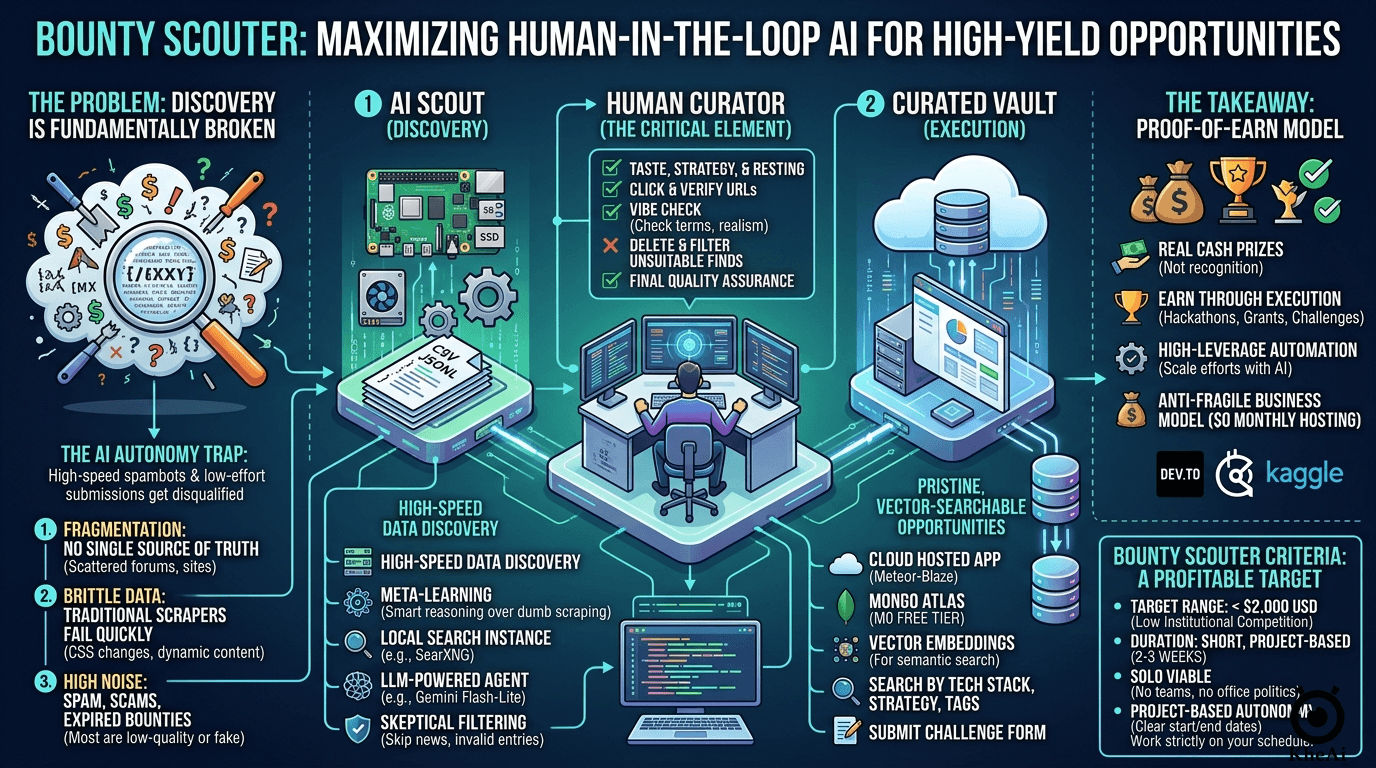
The Problem: The High Cost of Discovery
There is real money to be made on the internet if you know how to build. High-yield, low-competition challenges, hackathons, and grants are out there. But they are scattered across a fragmented digital wasteland.
To stay competitive, you traditionally have to monitor Dev.to, Gitcoin, Kaggle, HackerNews, X (Twitter), Nostr, and dozens of niche Layer-1 blockchain forums.
The discovery process is fundamentally broken for three reasons:
- Fragmentation: There is no “Single Source of Truth.” Opportunities are siloed across platforms that don’t talk to each other.
- Brittle Data: Traditional web scrapers are a nightmare to maintain. They break the moment a platform changes a single CSS class name or updates its React DOM structure.
- Noise: Most “bounties” you find are either scams, expired, or demand enterprise-level architecture for pennies.
I realized I was spending 80% of my time looking for work and only 20% of my time executing it. The math was backwards.
The Solution: Intelligent Scouting over Dumb Scraping
Instead of building a dozen brittle custom scrapers, I pivoted to a meta-learning approach. I built a system that acts as an intelligent agent capable of reasoning, rather than a dumb script looking for HTML tags.
I transitioned my architecture from a complex, heavy backend to a sleek, multi-stage pipeline: Global Scout Human Curator Cloud Vault.
Phase 1: The Autonomous Scout (Local Discovery)
The first layer runs locally on a simple, low-power machine (like a Raspberry Pi). Its only job is background discovery. Using an LLM-powered agent connected to a private search instance, it methodically scours the web using highly specific, niche search queries (e.g., “indie developer bounty”, “web3 grant programs”).
It doesn’t just download links; it reads the search snippets, applies a skeptical filter, and rejects anything that looks like a news article, lacks a clear prize pool, or has already been discovered. The surviving, verified challenges are neatly logged into a local file.
Phase 2: The Human Filter (Taste & Strategy)
This is where the magic happens, and where full autonomy fails. Every morning, I open the raw list generated by the scout.
I act as the final quality assurance layer. I click the links. If a challenge has terrible terms and conditions, if the timeline is unrealistic, or if the “vibe” is just wrong, I delete it. The AI found the ore; I am the one panning for the gold.
Phase 3: The Curated Vault (Cloud Execution)
For the high-value targets that survive my manual review, I log them into a sleek, cloud-hosted web app I built. This app vectorizes the data, making it searchable by tech stack and strategy. The unstructured chaos of the web is successfully transformed into a pristine, highly curated vault of opportunity.
The Takeaway
We need to stop trying to automate ourselves out of the equation.
AI is an incredible tool for lifting the heavy, tedious burdens of data aggregation and discovery. But strategy, skepticism, and taste are inherently human traits. By building a system that respects both—deploying AI for speed and humans for curation—you stop spinning your wheels in the digital noise and start executing on opportunities that actually matter.