Most people treat bookmarks, “Watch Later” playlists, and databases like external hard drives for their brains. This is the Collector’s Fallacy: the dangerous illusion that the act of acquiring information is the same as learning it.
In an era of high volatility, a library of unread PDFs is a liability. You do not need more data; you need an active, executable knowledge base. This blueprint engineers the transition from a passive consumer to a definitive knowledge architect, balancing brutal efficiency with the necessary context for actual understanding.
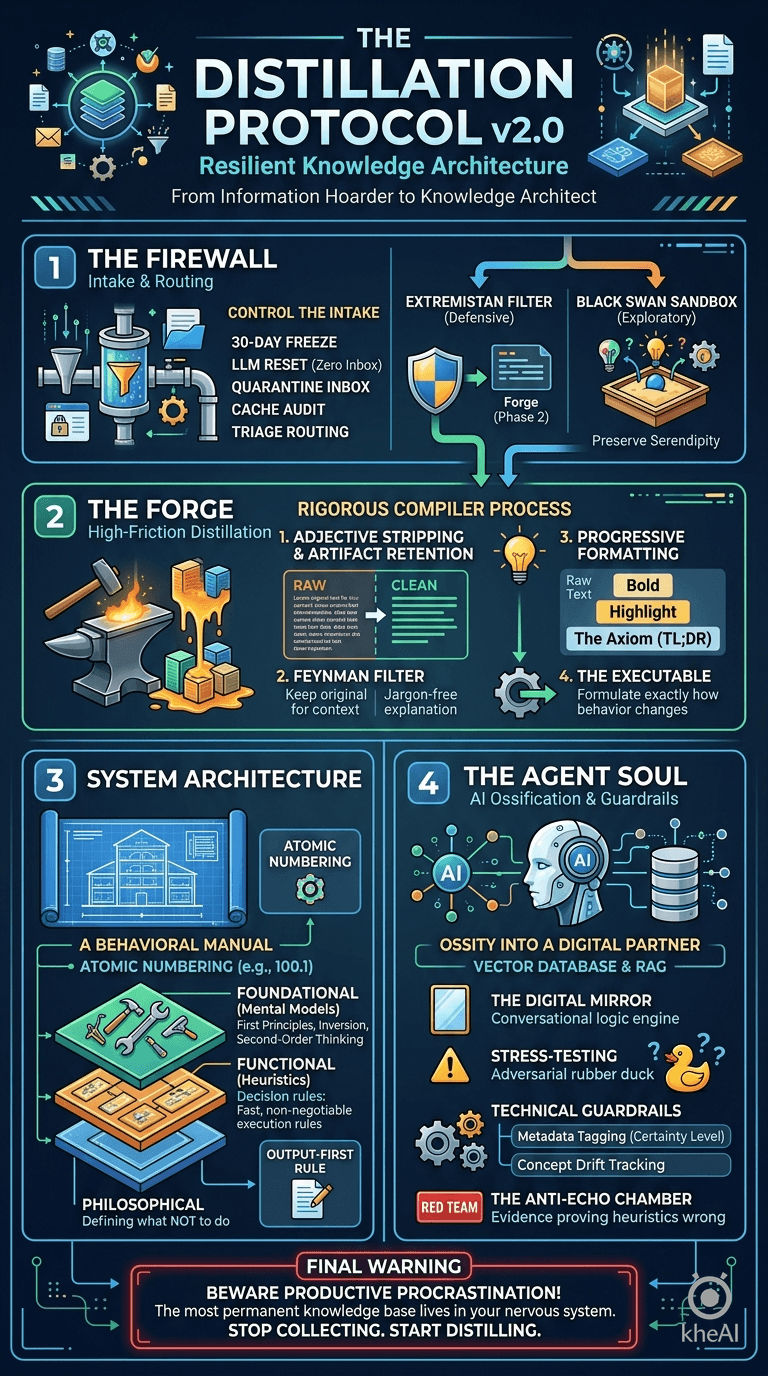
Phase 1: The Firewall (Intake & Routing)
Before building, clear the site. You cannot distill clean water from a fire hose of raw data. This phase controls the intake and categorizes information before it demands your cognitive load.
- The 30-Day Freeze: Halt all new newsletters, book purchases, or “thought leader” follows.
- The LLM Reset (Zero Inbox): Clear your AI chat memories and temporarily uninstall brainstorming apps. Stop generating new ideas until you have processed existing ones.
- The Quarantine Inbox: Treat all incoming data as untrusted code. Never save an article directly into your permanent system. Route everything here first.
- The Cache Audit: Review existing notes. If you cannot explain the core concept without clicking the embedded link, you merely outsourced its location. Delete it or quarantine it.
- Triage Routing (The Split Filter): Not all knowledge requires the same friction. Route quarantined data through two distinct filters:
- The Extremistan Filter (Defensive): For foundational models. Ask: “Does this help me make better decisions when things go wrong?” If yes, route to The Forge (Phase 2).
- The Black Swan Sandbox (Offensive/Exploratory): A low-friction space for high-variance, seemingly irrelevant reading. This preserves non-linear creativity and serendipity. Concepts here remain as searchable snippets until actively needed for a project.
Phase 2: The Forge (High-Friction Distillation)
Knowledge is an action, not an asset. Information routed here must survive a rigorous compiler process to enter the permanent OS.
- Adjective Stripping & Artifact Retention: Extract the verifiable physics and structural mechanics of the idea, deleting the author’s narrative and emotional appeals. Crucially: Always retain an unmodified clone of the original source text in a collapsed toggle or linked metadata. This preserves the semantic context required for biological memory and future AI vector retrieval.
- The Feynman Filter: Explain the stripped concept in three sentences without jargon. Echoing the author’s words indicates a lack of understanding.
- Progressive Formatting: Layer the note for your future self so the “soul” of the idea is visible in 30 seconds:
- Raw Text: The original quote or idea.
- Bold: Highlight the most critical sentences.
- Highlight: Mark the absolute best parts of the bolded text.
- The Axiom (The Physics): Write a 1-paragraph “TL;DR” executive summary at the top in your own voice.
- The Executable (The Script): Formulate exactly how this information changes your daily operation. If a foundational note lacks an executable script or a change in behavior, it is bloatware. Delete it.
Phase 3: System Architecture
Your permanent base is a behavioral manual, not a wiki of random facts. Structure your knowledge into three distinct layers using an Atomic Numbering system (e.g., 100.1) to allow cross-referencing without burying concepts in nested folders (Dewey-Decimal or Zettelkasten).
| Layer | Component | Purpose |
|---|---|---|
| Foundational | Mental Models | High-leverage analytical tools (e.g., First Principles, Inversion, Second-Order Thinking). |
| Functional | Heuristics | Fast, non-negotiable execution rules. “If [X] happens, do [Y].” |
| Philosophical | Via Negativa | Defining what not to do (e.g., “I do not consume seed oils” is stronger than “I try to eat healthy”). |
The Output-First Rule: Stop consuming to “be informed.” Consume to solve a specific problem. Reading with the intent to build a project, write an essay, or win an argument forces your brain to hook onto actionable patterns.
Phase 4: The Agent Soul (AI Ossification & Guardrails)
Once notes are distilled and contextualized, “ossify” them into a digital partner using a Vector Database and Retrieval-Augmented Generation (RAG).
- The Digital Mirror: Feed your distilled protocol (and the retained source artifacts) into a private AI. You now have a logic engine that argues with you using your own frameworks.
- Stress-Testing: Use the bot as an adversarial rubber duck. Prompt it: “Identify the critical flaw, contradiction, or missing context in my current strategy for [X].”
- Technical Guardrails (Skeptical Engineering):
- Metadata Tagging: Tag every entry by “Certainty Level” (e.g.,
Speculative,Proven,Heuristic). - Concept Drift Tracking: When adding new data, actively challenge old truths; do not let the system silently overwrite them.
- Metadata Tagging: Tag every entry by “Certainty Level” (e.g.,
- The Anti-Echo Chamber: Build a dedicated “Red Team” section explicitly labeled: “Evidence that proves my current heuristics wrong.” A system that only validates your biases is compromised.
Additional Readings & Reference (Archived Rules)
- The Absolute Extremistan Filter: The original framework required all data to pass the Extremistan test (“Keep only what helps you navigate uncertainty”). This was archived because it over-optimized for defense and actively killed serendipitous innovation.
- Universal Forging: The original protocol subjected all notes to Phase 2. This was deprecated. Applying maximal friction to every piece of data inevitably leads to system abandonment. The Triage step was added to prevent cognitive bottlenecks.
- Pure Adjective Stripping: The previous instruction to completely delete all narrative was modified. Stripping narrative entirely destroys the cognitive hook that makes ideas stick and degrades LLM retrieval quality. The “Artifact Retention” protocol was introduced to solve this.
- OpenClaw Agent SOUL.md?
The Final Warning: Beware Productive Procrastination
It is dangerously easy to spend six months organizing a database while never changing your actual behavior. An imperfect system executed ruthlessly will always outperform a flawless system that requires too much willpower to maintain.